
SynapseRx The Causal Engine for Omnichannel Prescribing.
The Prescriptive Path: Integrating EHR, Claims, and Media Data for Predictive Pharma Marketing and Commercial Solution Development

The Attribution Chasm
The pharmaceutical industry faces a persistent challenge: accurately attributing marketing spend to prescribing behavior. Traditional attribution models often fail to account for the complex, non-linear journey of the Healthcare Professional (HCP) and the patient. This gap, the "Attribution Chasm," hinders effective budget allocation, limits ROI, and prolongs time-to-market penetration.
Inaccurate Attribution Models
Relying on simple last-click or time-decay models that ignore the clinical journey (EHR) and treatment continuity (TBRx).
Wasteful Spend
Inability to isolate HCPs who engage with campaigns but are clinically unlikely to prescribe (low-value engagement).
Reactive Strategy
Marketing based on historical prescribing patterns (Claims) rather than proactive identification of future prescribers (EHR potential + Engagement).
The Interlocking Data Ecosystem
To move beyond simple correlation, pharma brand teams must establish a unified view of the market by linking the following data sets using privacy-compliant, de-identified keying methodologies.
EHR Data Platforms & Aggregators
EHR data provides the essential clinical "why" behind prescribing decisions. It allows for a granular understanding of the patient cohort that is eligible for the brand.
- Clinical Triggers: Identifying specific lab results, diagnostic criteria (e.g., HbA1c levels, tumor markers), or procedure codes
- Treatment Pathway Mapping: Understanding prior treatment failures, contraindications, and specialist referrals
- HCP Profile Deep Dive: Mapping the volume of clinically relevant patients treated by an HCP
Claims Data
Claims data provides the indisputable commercial "what"—the prescription event itself (NBRx) and the subsequent refill behavior (TBRx).
- Lagging Indicators: Tracking the ultimate outcome (prescription fill) following marketing exposure
- Adherence/Persistence Metrics: Detailed analysis of refill patterns for high or low TBRx rates
- Payer and Access Impact: Quantifying the effect of formulary changes or patient financial assistance programs
Media Agency Campaign Data
Data from media partners supplies the promotional "how"—the digital touchpoints and engagement metrics that inform the HCP.
- Attribution Fingerprints: Logging every digital interaction (impressions, clicks, video completion, social engagement)
- Frequency and Reach Analysis: Optimizing exposures required to influence a prescription
- Content Performance: Linking specific creative executions or educational content (A/B testing) to NBRx performance
Prescriptive Path Model (PPM)
We propose the development and implementation of the Prescriptive Path Model (PPM)—an advanced analytical and operational solution built on integrated data. The PPM is not just a reporting tool; it is a predictive engine that optimizes marketing deployment in real-time.
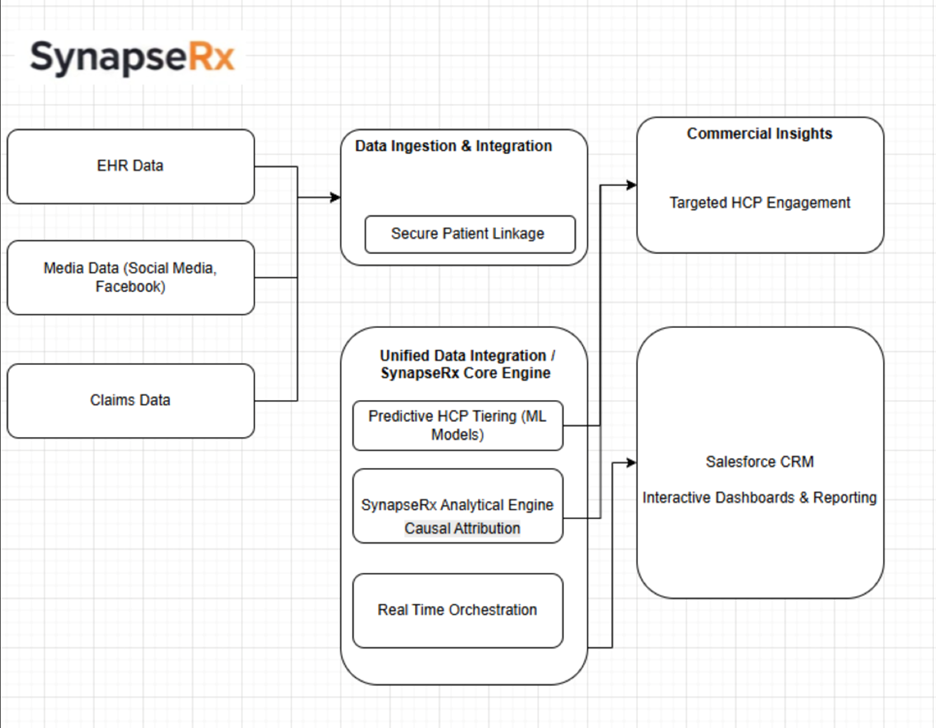
Predictive HCP Tiering
EHR-Claims Synthesis
Function: Uses Machine Learning (ML) to score every HCP based on the probability of prescribing the brand within the next 90 days.
Input: High-dimensional features from EHR (number of clinically relevant patients, average severity) combined with Claims data (historical prescribing habits, competitor usage).
Causal Attribution Engine
Media-Rx Linkage
Function: Applies Causal Inference Modeling (e.g., difference-in-differences, uplift modeling) to quantify the net incremental NBRx and TBRx lift generated solely by media exposure.
Input: Individual-level media exposure logs (treatment group) vs. unexposed control groups, linked to prescription outcomes.
Real-Time Intervention Orchestration
Operational Layer
Function: An operational layer that uses the Predictive Tiering scores and Causal Attribution ROMI to automatically adjust campaign parameters.
Real-Time Intervention Examples
See how the PPM orchestration layer responds to real-world clinical and commercial signals.
New Prescription Acceleration
If the model predicts a specific HCP tier is highly likely to start prescribing based on a new lab result (EHR trigger), media frequency is instantly boosted to that HCP via media platforms.
Adherence Intervention
If Claims data identifies a cluster of patients at high risk of non-adherence, the orchestration layer shifts media spend to target those patients' prescribers with adherence-focused content.
Partnership Pathway
This integrated approach represents a significant opportunity for pharma brands and their commercial partners. The ultimate solution is the service offering itself: a managed analytics platform that guarantees incremental NBRx and sustained TBRx by closing the Attribution Chasm with predictive, clinically-informed marketing execution.
| Partner Role | Contribution to PPM Solution |
|---|---|
| Pharma Brand Teams | Provide domain expertise, define NBRx/TBRx goals, and validate clinical triggers. |
| EHR/Claims Aggregators | Supply the core RWD (longitudinal patient journey) and the compliant data linkage framework. |
| Media Agencies | Provide the digital engagement data and the operational platform to execute optimized, real-time media deployment. |
| 609 Health (Solution Provider) | Develop the Prescriptive Path Model (PPM), housing the ML algorithms, Causal Inference Engine, and the orchestration layer connecting data streams. |
From Retrospective Reporting to Predictive Strategy
By dissolving the silos between clinical (EHR), commercial (Claims), and promotional (Media) data, the Prescriptive Path Model (PPM) transforms pharma marketing from a retrospective reporting function into a predictive, strategic asset. This integrated solution provides the granular insights needed to justify every dollar of marketing spend by proving its direct causal link to prescriptions.
Next Step: We propose a pilot program to implement the Prescriptive Path Model (PPM) solution with a key brand team, focusing on a single therapeutic area.
Schedule Discovery Session →